
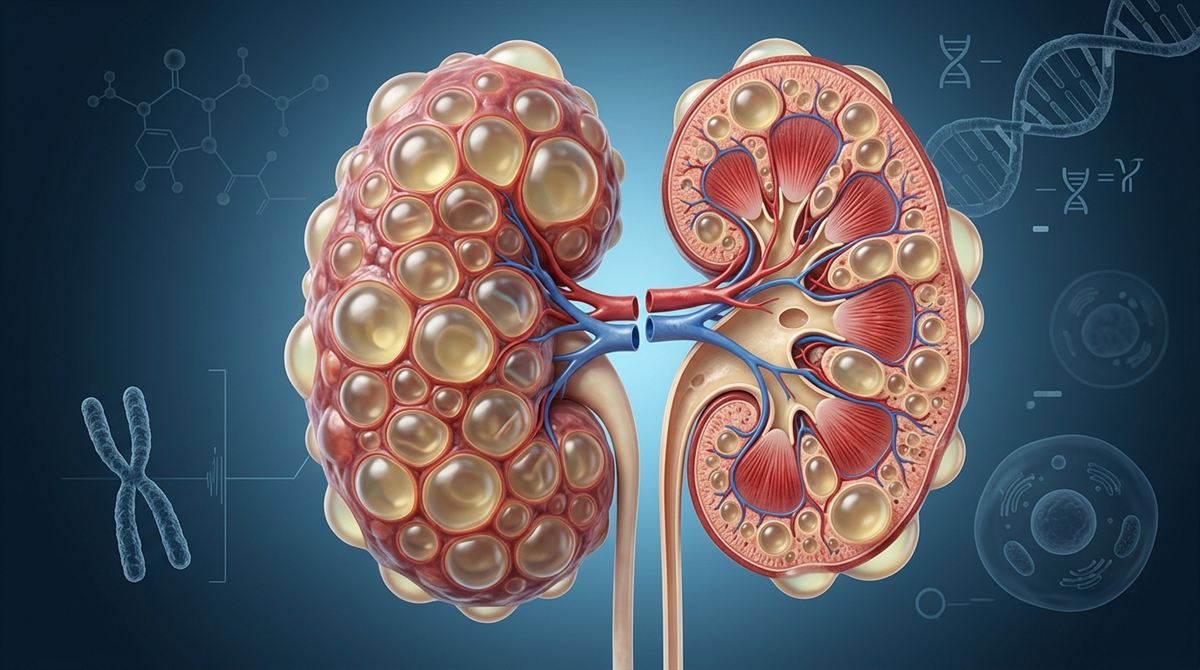
1. What is Autosomal Dominant Polycystic Kidney Disease?
Autosomal Dominant Polycystic Kidney Disease (ADPKD) is the most prevalent life-threatening genetic disorder in nephrology, accounting for approximately 5–10% of all patients on maintenance dialysis worldwide. Because it is inherited in an autosomal dominant pattern, an affected parent has a 50% chance of passing the altered gene to each biological child.
Unlike simple, harmless kidney cysts commonly seen in normal physiological aging, ADPKD is a relentless, progressive condition. Over decades, fluid-filled cysts multiply and expand exponentially, compressing and destroying adjacent healthy renal parenchyma until overall kidney function fails.
2. Genetics: PKD1 vs. PKD2 Mutations
ADPKD is driven by mutations in one of two major genes:
- PKD1 Gene (Chromosome 16p13.3): Responsible for ~85% of cases. Encodes the protein Polycystin-1. Patients with PKD1 mutations experience faster cyst growth and typically reach end-stage renal disease earlier (average age 54–58 years).
- PKD2 Gene (Chromosome 4q21): Responsible for ~15% of cases. Encodes Polycystin-2. Produces a milder clinical course, with dialysis onset typically delayed until age 70 or beyond.
3. Clinical Symptoms & Extra-Renal Manifestations
Although ADPKD is present from birth, symptoms typically surface between ages 25 and 45:
- Early-Onset Hypertension: Often the earliest clinical manifestation, appearing before any decline in serum creatinine. Expanding cysts compress renal arterioles, activating intense intrarenal renin release.
- Chronic Flank and Abdominal Pain: Caused by stretching of the renal capsule, mechanical crowding of abdominal organs, or cyst hemorrhage.
- Gross Hematuria (Blood in Urine): Occurs when a cyst wall ruptures into the renal collecting system. While frightening, cyst hemorrhage is usually self-limiting with bed rest and hydration.
- Cyst Infections & Pyelonephritis: Characterized by high-grade fever, chills, and sharp localized flank tenderness, requiring lipophilic antibiotics (like Fluoroquinolones) that penetrate cyst walls.
- Polycystic Liver Disease: Up to 80% of ADPKD patients develop benign hepatic cysts by age 40, which enlarge the liver but rarely impair liver function.
- Intracranial Berry Aneurysms: Approximately 8–12% of ADPKD patients develop intracranial aneurysms in the cerebral Circle of Willis. Magnetic Resonance Angiography (MRA) screening is strongly advised for patients with a family history of aneurysms or subarachnoid hemorrhage.
4. Breakthrough Disease-Modifying Therapy: Tolvaptan
For decades, ADPKD treatment was purely reactive. Today, Tolvaptan represents a monumental paradigm shift. Tolvaptan is an oral, selective vasopressin V2-receptor antagonist that blocks cyclic AMP (cAMP) inside tubular epithelial cells—the primary molecular engine that drives cyst fluid secretion and cell proliferation.
Landmark clinical trials (TEMPO 3:4 and REPRISE) demonstrated that Tolvaptan slows kidney enlargement by nearly 50% and reduces the annual decline in eGFR by approximately 1.0 to 1.5 mL/min/year, effectively delaying dialysis initiation by 4 to 7 years!
Nephrologist's Clinical Pearl — Dr. Fayaz Ahmad Wani
"If someone in your family has polycystic kidney disease, do not wait for back pain or hematuria to get checked. A simple, painless renal ultrasound performed in your 20s can identify cysts early. Early blood pressure optimization with ACE inhibitors and high fluid intake suppresses vasopressin and significantly delays cyst expansion."
5. Essential Daily Management for ADPKD Patients
- High Fluid Intake: Drink 3 to 4 liters of water evenly spread throughout the day and night. Abundant water suppresses pituitary vasopressin release, acting as a natural brake on cyst growth.
- Strict Blood Pressure Target: Maintain BP < 120/80 mmHg using RAAS blockers (ACEi/ARBs) as first-line therapy.
- Limit Dietary Sodium & Caffeine: Keep salt under 2,000 mg/day. Restrict high caffeine intake (coffee, energy drinks), as caffeine increases intracellular cAMP levels, fueling cyst enlargement.
📚 Peer-Reviewed Clinical References & Guidelines
- KDIGO Controversies Conference on Autosomal Dominant Polycystic Kidney Disease (ADPKD) ↗
- New England Journal of Medicine (NEJM): Tolvaptan in Patients with Autosomal Dominant Polycystic Kidney Disease (TEMPO 3:4) ↗
- PKD Foundation - Polycystic Kidney Disease Clinical Resources ↗
- Fortis Escorts Hospital Amritsar - Department of Nephrology & Genetic Renal Care ↗
Frequently Asked Patient Questions
Can polycystic kidney cysts become cancerous?
No. ADPKD cysts are completely benign fluid-filled structures. They do not transform into renal cell carcinoma, although their massive size causes mechanical pressure on surrounding organs.
Can kidney cysts in ADPKD be surgically removed or drained?
Draining or deroofing cysts is reserved only for isolated, exceptionally large, infected cysts causing severe localized pain. It does not halt overall disease progression because thousands of smaller microscopic cysts will continue to enlarge.
Is kidney transplantation an option for ADPKD patients?
Yes! Kidney transplantation is exceptionally successful for ADPKD patients. Cysts do NOT recur in the newly transplanted donor kidney, and long-term graft survival rates are among the highest of any renal disease category.
Related Kidney Health Articles
"Medical education empowers patients to make informed, life-saving choices. When we catch kidney decline early, modern nephrology has the tools to protect your kidneys for decades."
— Dr. Fayaz Ahmad Wani
MD (General Medicine), DM Nephrology (Osmania Medical College)
Senior Consultant Nephrologist & Kidney Transplant Specialist
Fortis Escorts Hospital ↗ & Revive Health Clinic, Amritsar