
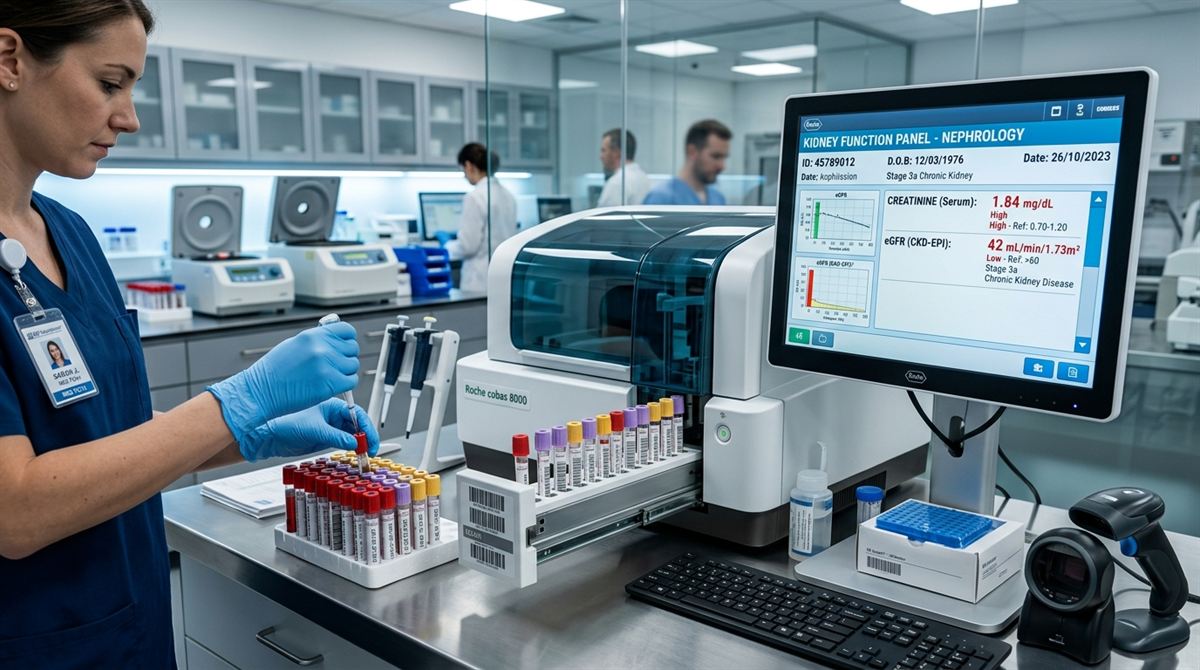
1. The Panic of a High Creatinine Report
Every single day in our nephrology clinic at Fortis Escorts Hospital Amritsar, patients arrive clutching laboratory reports in distress because their serum creatinine returned at 1.4 or 1.6 mg/dL. To understand whether this indicates true kidney disease, we must first understand what creatinine actually is.
Creatinine is NOT a toxin in itself; it is a harmless metabolic waste product generated constantly by your muscles during normal physical movement. Because healthy kidneys filter creatinine out of the blood at a steady rate through glomerular filtration without reabsorbing it, measuring creatinine levels in the bloodstream serves as a convenient indirect barometer of kidney clearance.
2. Why Creatinine Alone Can Be Deceptive
The major flaw with relying solely on serum creatinine is that its production is directly proportional to muscle mass, age, gender, and diet:
- The Muscular Athlete: A 25-year-old bodybuilder with large muscle mass may have a creatinine of 1.4 mg/dL with 100% healthy kidneys simply because their muscles generate more daily waste.
- The Frail Elderly Patient: An 80-year-old grandmother weighing 40 kg may have a creatinine of 0.8 mg/dL (appearing 'perfect' on a generic lab reference range) while her actual kidneys are operating at only 30% capacity due to diminished muscle production!
3. Enter eGFR: The True Standard of Kidney Function
To eliminate the confounding effect of muscle mass and age, nephrologists convert serum creatinine into an estimated Glomerular Filtration Rate (eGFR) using validated mathematical formulas (such as the CKD-EPI 2021 Creatinine Equation):
- eGFR > 90 mL/min: Normal or high kidney filtration function.
- eGFR 60–89 mL/min: Mildly decreased kidney function (common in healthy aging if no proteinuria is present).
- eGFR 45–59 mL/min (CKD Stage 3a): Mild to moderate reduction; warrants formal nephrology evaluation.
- eGFR 30–44 mL/min (CKD Stage 3b): Moderate to severe reduction; active medical intervention required to halt decline.
- eGFR 15–29 mL/min (CKD Stage 4): Severe reduction; preparation for kidney replacement therapy or preemptive transplant.
- eGFR < 15 mL/min (CKD Stage 5): End-Stage Renal Disease (ESRD).
4. Non-Kidney Causes of Temporary Creatinine Spikes
Before diagnosing irreversible kidney damage, nephrologists rule out transient benign causes:
- Acute Dehydration: Severe vomiting, diarrhea, heat exposure, or inadequate fluid intake temporarily decreases blood flow to the kidneys (prerenal azotemia), causing creatinine to rise transiently.
- Cooked Meat Consumption: Eating large amounts of grilled red meat within 12 hours of a blood test artificially spikes serum creatinine, as dietary creatine is converted into creatinine during cooking.
- Strenuous Resistance Training: Heavy gym workouts cause microscopic muscle breakdown that temporarily raises blood levels.
- Medication Interference: Certain drugs (e.g., Trimethoprim, Cimetidine) inhibit tubular secretion of creatinine without altering true glomerular filtration rate.
Nephrologist's Clinical Pearl — Dr. Fayaz Ahmad Wani
"Never panic over a single isolated creatinine value from an outpatient lab. In my clinical practice, we always repeat the test in a properly hydrated state alongside a Spot Urine Albumin-to-Creatinine Ratio (uACR) and a Renal Ultrasound. If protein is absent from the urine and kidney architecture is healthy on ultrasound, a mildly elevated creatinine is frequently benign."
5. What to Do If Your Creatinine is Genuinely Elevated
If persistent renal decline is confirmed, taking the following proactive steps protects remaining nephrons:
- Consult a Nephrologist Promptly: Do not rely on generic remedies or unverified herbal tonics, which frequently contain heavy metals that accelerate kidney destruction.
- Strictly Avoid NSAID Painkillers: Avoid Brufen, Voveran, Combiflam, and Diclofenac. Use Paracetamol safely under medical guidance.
- Optimize Blood Pressure & Blood Sugar: Tight vascular control reduces intraglomerular stress and preserves renal longevity.
📚 Peer-Reviewed Clinical References & Guidelines
- National Kidney Foundation (NKF) & American Society of Nephrology (ASN) Task Force on Reassessing the Inclusion of Race in Diagnosing Kidney Disease ↗
- KDIGO 2024 Clinical Practice Guideline for the Evaluation and Management of Chronic Kidney Disease ↗
- New England Journal of Medicine (NEJM): A New Equation to Estimate Glomerular Filtration Rate ↗
- Fortis Escorts Hospital Amritsar - Department of Laboratory Medicine & Nephrology ↗
Frequently Asked Patient Questions
Can drinking lots of water lower my creatinine?
If your creatinine was elevated due to mild dehydration, rehydrating will normalize it. However, if kidney tissue has been scarred, excessive water intake cannot wash away scarred nephrons and can cause dangerous fluid overload.
Is Blood Urea the same as Serum Creatinine?
No. Blood Urea Nitrogen (BUN) is a waste product of dietary and bodily protein metabolism. Urea fluctuates wildly with dietary protein intake, dehydration, fever, and steroid use, making creatinine a much more stable marker of renal filtration.
Are herbal and Ayurvedic kidney cleansers safe for lowering creatinine?
Caution is strongly advised. Many unregulated herbal formulations contain high potassium, unknown diuretics, or heavy metals (lead, mercury, arsenic) that cause catastrophic acute interstitial nephritis and permanent dialysis dependency.
Related Kidney Health Articles
"Medical education empowers patients to make informed, life-saving choices. When we catch kidney decline early, modern nephrology has the tools to protect your kidneys for decades."
— Dr. Fayaz Ahmad Wani
MD (General Medicine), DM Nephrology (Osmania Medical College)
Senior Consultant Nephrologist & Kidney Transplant Specialist
Fortis Escorts Hospital ↗ & Revive Health Clinic, Amritsar